As with most people that have heard the police and the anti-extradition-law
march organisers, I wondered how they go about estimating the number of people
taking part in protest events, and why they came up with such widely different
figures.
It turns out that the reason being the latter is a lot less
nefarious than most would imagine; the police’s goal in their estimate is to
evaluate the required containment forces at an event, while the organisers’ is
to measure participation.
I did reach out to the Hong Kong police but got referred to
their research arm and asked to fill an irrelevant form; they obviously had no
desire to share the methods they use to come-up with their estimates. However, an
April 29th, 2019 SCMP article by Sum Lok-Kei confirms the police’s crowd-sizing
goals: ”Instead of estimating the total turnout of marchers, police publish
a figure for what they believe to be the peak of the processions.
A police spokesman said on Monday that officers counted
the number of marchers from ‘multiple high points’.
‘The number of participants in public meetings and
processions estimated by police is only a rough figure solely for the purpose
of effective manpower deployment,’ he said.
Police did not disclose if any equipment or methods were
used in making the estimation.”
In itself, this informs us that the police estimates cannot
be used to assess turnout in any event as it is obvious that people will come
and go during static gatherings. In the case of the June 9th and 16th
2019 events, these were marches; the ‘peak’
numbers should therefore be multiplied by a certain factor which would
correspond to the flow of people over the time period. That is; how many times
did the stream of people covering the full length of the march was fully replaced
by marchers behind them.
The Hong Kong University Public Opinion Program does have
quite a rigorous method where they measure the flow of people going through a single
point along the marching route over 2 hours period, then multiply to account
for the march’s duration, then survey marchers to assess how many would have
joined before or after the checkpoint.
This is also the method privileged by Dr. Keith Still, professor
of Crowd Science at Manchester Metropolitan University. There’s a quite
detailed explanation of various methods provided in a Reuters article here: https://graphics.reuters.com/HONGKONG-EXTRADITION-PROTESTS/0100B01001H/index.html
Actually, Dr. Still gracefully agreed to let me refer to his
crowd density illustrations.
But, I wondered, isn’t there a way for the common individual
to get an independant idea of the crowd size?
Turns out there is; there are a number of online tools that
help with crowd-counting. I used MapChecking.com which is very easy-to-use. The
only thing it needs is for you to plot the area where the event took place,
then assign a crowd density ratio.
The area was easy enough to plot provided that it was
clearly recognized by both the organisers and the police. You can find the fully
plotted map here:
Then, it is a matter of evaluating the crowd-density. Below
are a few pictures from June 9th along the route (Src: Apple Daily):


From Dr. Still’s web site, we can find a few visual references
as to crowd density which I used here with his permission: http://www.gkstill.com/Support/crowd-density/625sm/Density6.html
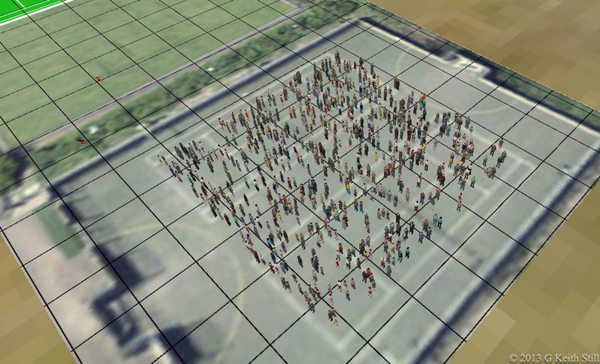
Density of 1 person/sqm
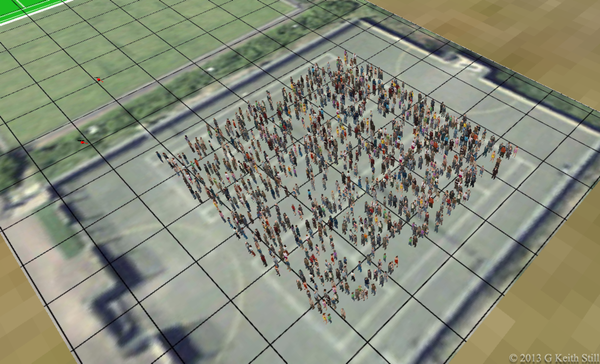
Density of 1.5 person/sqm
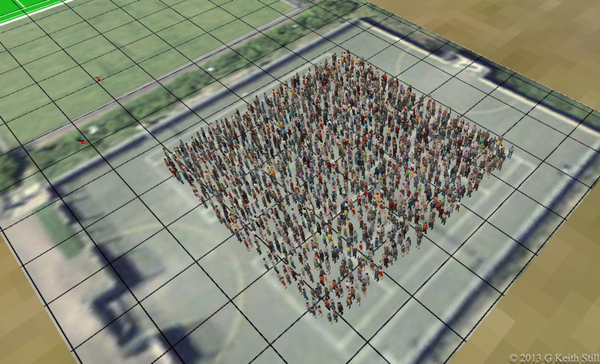
2/sqm
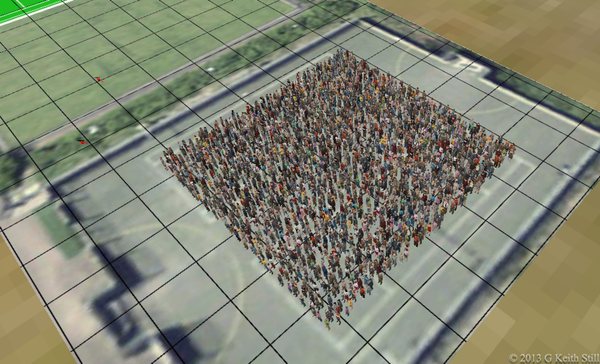
3/sqm
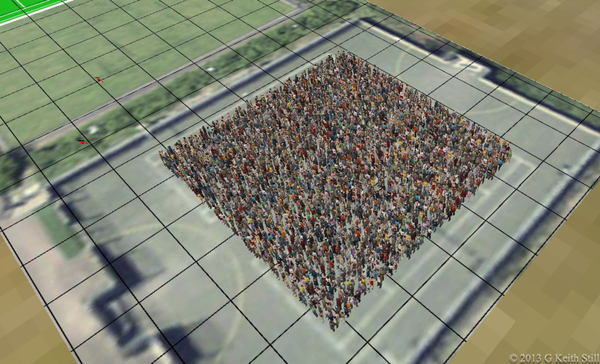
4/sqm
To my untrained eyes, I would say the crowd density was
between 3 and 4 people per square metre. And let’s pick a lower bound, which I
would call the ‘reality-denying-evaluation’ of 1.5 per sqm, as it is clearly
obvious but for the staunchest of Pooh supporter, that the density was far
higher.
Plugged into the tool, that still gives us roughly 160,000
people.

But wait, people did not just occupy the roads, they also
were moving towards Tamar. Let’s say, for the sake of pleasing the police
evaluators, that there was only 1.5 full movement of people, meaning that the
actual number of people is 1.5 times the road surface covered, that’s about
240,000 people. So, there you have it; the reality-defying lower-bound is the
actual police figure. It should be quite clear that this number is
underestimating the flow and/or the density but we also do know that the police
does not claim to count total participation but rather, peak participation.
However, any number lower than 240,000 claiming to measure
total turnout is just pure political fabrication and can be rejected outright. Incidentally,
this is exactly what Francis Lui Ting-Ming, researcher for Beijing-backing Out
Hong Kong Foundation did, pegging the count at less than 200,000!
Let’s now try a more realistic number; let’s see with 3.3 which
is consistent with Francis Lui Ting-Ming’s figure (so, likely to be higher) and
the actual pictures of the march. The tool gives us an estimate of roughly
350,000 people.

And if we go with a more realistic 2 times movement, we are
at 700,000 marchers.
Remember however that this method makes assumptions around constant
density and crowd movements, which HKUPOP’s or Dr Still’s currently point out
as being adding to the error margin. However, provided that all methods have
difficulty accounting for alternate marching routes and people joining in and
out at different points, I would think that the true account of turnout is probably
somewhere between the HKUPOP’s figure and the ones evaluated here.
All-in-all, 1 million is not a huge stretch; it is very
possible that the density was actually slightly higher at 3.5, and that there
were 2.5 to 3 times movement if all alternate routes were counted.
One thing that is undeniable; for this many Hong Kongers to take
the street at 30c and 80% humidity, it is quite clear what they wanted to be heard,
and that the vast majority, even the almost totality of the population was
against the bill and wanted to see it dropped.
Sources:
https://graphics.reuters.com/HONGKONG-EXTRADITION-PROTESTS/0100B01001H/index.html
-------------------------------
ASI used Trending Moving Average(TMA) system to conduct analysis online via keywords such as ‘Victoria Park’, ‘Protest’, ‘Civil Human Rights Front’ and ‘1st July’. The results showed that the number of protestors will range between 585,000 (lower threshold) and 840,000 (maximum cap). The % probability of the lower threshold and maximum turn-out is at 71% and 69.3% respectively."
https://www.dimsumdaily.hk/asi-analytics-media-asi-predicts-a-maximum-number-of-840000-protestors-to-turn-up-at-the-2-30pm-rally-later/
"ASI Analytics and Media used big-data system to analyze the turnout of yesterday's march and estimated about 550,000 people joined the rally.
The company said the turnout was lower than the two anti-fugitive law marches last month but it exceeded the 2003 record for a July 1 rally of 500,000. Police said the turnout was 190,000."
http://www.thestandard.com.hk/section-news.php?id=209175
If the HKPF was truly assessing the total turnout, their number is fabricated and politically motivated in light of the assessment by a 3rd party (ASI A&M). Especially when compared to their 2003 estimates. Now, if they measured peak attendance, 190k is possible as it would mean there was roughly 3 crowd movements during the march.
-------------------------------
Notes on July 1st crowd size
"According to ASI Analytics & Media (ASI), an estimated maximum number of 840,000 protestors is expected to turn up for the anti-extradition march this afternoon at 2.30pm. ASI predicted that the number will be significantly less than the last two Sunday rallies due to lethargy and Hong Kongers going on vacation during the long weekend.ASI used Trending Moving Average(TMA) system to conduct analysis online via keywords such as ‘Victoria Park’, ‘Protest’, ‘Civil Human Rights Front’ and ‘1st July’. The results showed that the number of protestors will range between 585,000 (lower threshold) and 840,000 (maximum cap). The % probability of the lower threshold and maximum turn-out is at 71% and 69.3% respectively."
https://www.dimsumdaily.hk/asi-analytics-media-asi-predicts-a-maximum-number-of-840000-protestors-to-turn-up-at-the-2-30pm-rally-later/
"ASI Analytics and Media used big-data system to analyze the turnout of yesterday's march and estimated about 550,000 people joined the rally.
The company said the turnout was lower than the two anti-fugitive law marches last month but it exceeded the 2003 record for a July 1 rally of 500,000. Police said the turnout was 190,000."
http://www.thestandard.com.hk/section-news.php?id=209175
If the HKPF was truly assessing the total turnout, their number is fabricated and politically motivated in light of the assessment by a 3rd party (ASI A&M). Especially when compared to their 2003 estimates. Now, if they measured peak attendance, 190k is possible as it would mean there was roughly 3 crowd movements during the march.

